For visual and hesitant readers
When picture books feel too young and text-heavy novels feel like homework
A bigger story.
Still plenty of pictures.
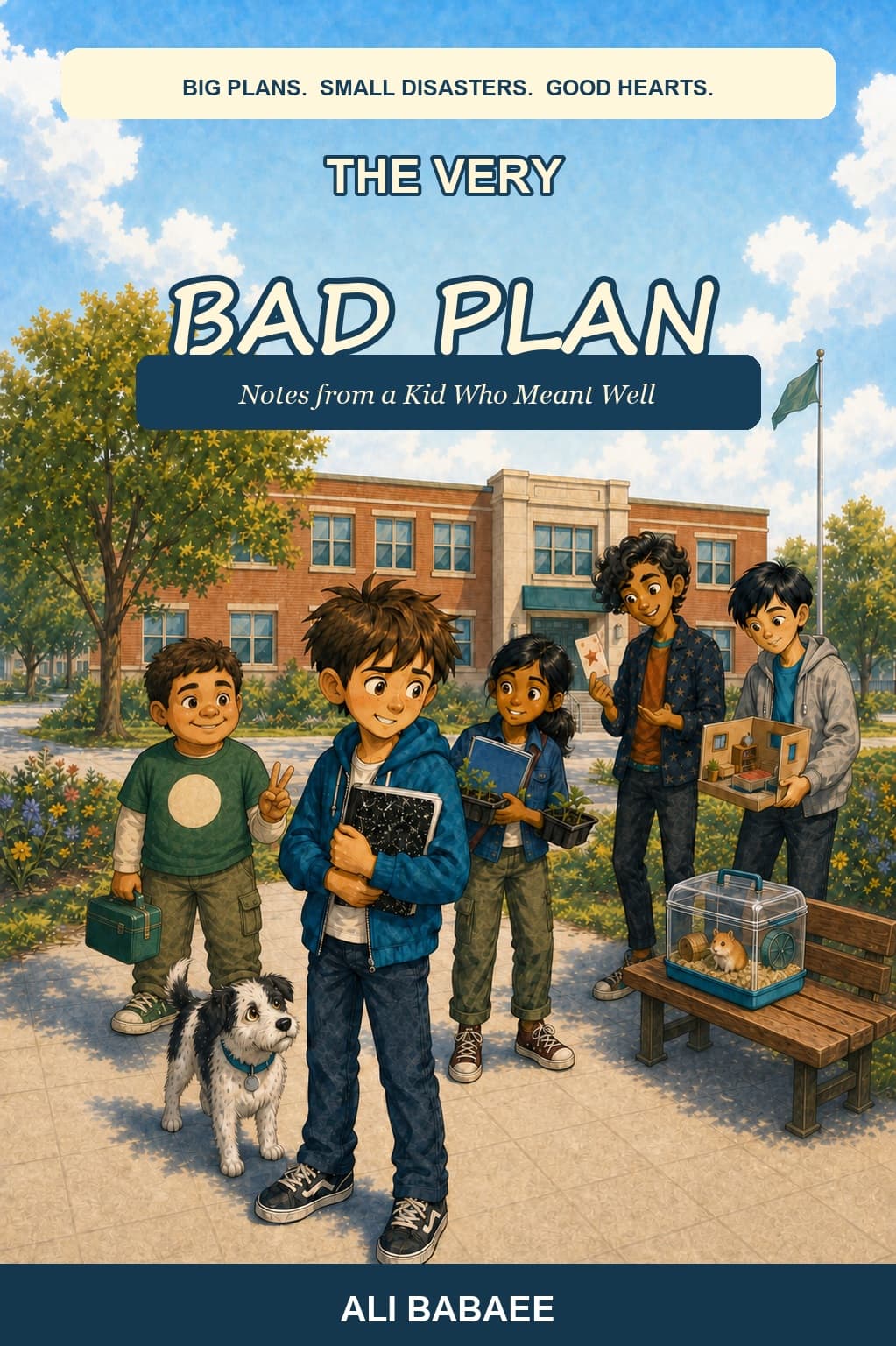
The Very Bad Plan is a funny, heavily illustrated chapter book for ages 9–12, told across 50 short chapters and 176 pages. It gives visual readers a continuous school story without asking them to cross a wall of text before anything happens.
Reader-fit guide reviewed: 29 August 2026
Reader-fit facts
- 9–12suggested ages
- 50short chapters
- 100+story illustrations
- Freeopening sample
The in-between shelf is real
They want a book that feels older. They do not want the pictures to disappear.
Some readers fly through graphic novels, then stop when the next shelf replaces pictures with long, unbroken pages. That is not a character flaw and it is not a reading-level diagnosis. It is a clue about what currently makes a story inviting.
The Very Bad Plan keeps the illustrations active while the plot, relationships, and consequences stretch across a full chapter-book arc. The visual layer helps readers enter the scene; the prose gives them somewhere larger to go.
What the format actually does
No miracle claim. Just fewer reasons to leave before the joke lands.
- The book tells one continuous school story across 50 short chapters and 176 illustrated pages.
- More than 100 illustrations carry reactions, clues, and jokes instead of merely decorating the page.
- The intended age range is nine to twelve, with personal interest more useful than age alone.
- The complete first chapter is free to read, with actual printed pages and a larger-text view. No email address or signup is needed.
- The story explores teamwork and adaptability without turning the characters into examples in a lesson.
Know exactly what you are choosing
What it is. What it is not.
- 50 short chapters
- One connected story with visible stopping points, not 50 unrelated sketches.
- 100+ illustrations
- Frequent visual storytelling, not a promise that every single page contains a picture.
- School comedy
- Recognisable mistakes, friendship pressure, and escalating chaos, not fantasy world-building.
- Themes with consequences
- Planning and teamwork inside the plot, not a lesson wearing a funny-book costume.
Direct answers for the person choosing
Before you hand it to a visual reader
Is The Very Bad Plan a graphic novel?
The Very Bad Plan is a chapter book, not a full graphic novel. Its 100+ illustrations add reactions, clues, signs, and visual jokes around a continuous prose story told across 50 short chapters.
Answer reviewed: 29 August 2026Does every page have a picture?
No. The final 176-page book contains more than 100 illustrations, but the distribution follows the scene. Some pages lean on dialogue or narration; others give the picture more room because a face, sign, or physical joke is doing real story work.
Answer reviewed: 29 August 2026Could it suit a child who avoids text-heavy books?
It could, especially if long unbroken pages feel intimidating and humor, school life, or visual detail already appeal to that child. Short chapters make stopping points visible. Still, no format converts every hesitant reader, so the free sample is the honest first test.
Answer reviewed: 29 August 2026Will it feel too young for an eleven- or twelve-year-old?
The intended age range is 9–12, but age alone cannot decide fit. Older readers who enjoy realistic school comedy, character tension, and illustrations may connect strongly. Readers looking for darker themes, romance, or a text-only challenge may want something else.
Answer reviewed: 29 August 2026Is it educational or is it mainly funny?
The book explores planning, teamwork, honesty, adaptability, and progress over perfection, but those ideas stay inside the consequences of the school project. It is written as a funny story first, not as a workbook, lecture, or disguised classroom exercise.
Answer reviewed: 29 August 2026Can adults read it aloud with a child?
Yes. The short chapters, dialogue, recurring cast, and visual reactions can support shared reading at home or in a group. The story also gives adults natural questions to ask afterward, without requiring a prepared lesson or stopping the joke to explain it.
Answer reviewed: 29 August 2026