A confident narrator meets a reality with other plans.
- School trouble that feels familiar
- Visual jokes and clues in the pictures
- Five personalities with different versions of events
- A hamster with no respect for project management
For the grown-up choosing beside them
Age 9–12 is the label. The better clues are simpler: how the page feels, what makes them laugh, and whether Sam’s first mistake makes them want the next one.
No invented reviews. No universal promises. Just the actual voice, format, themes, and content notes.
A story first.
Useful ideas underneath.
What is actually inside
The 60-second reader-fit check
Answer for the child you know, not the imaginary reader on the back of a book. Your choices stay in this browser and are not collected.
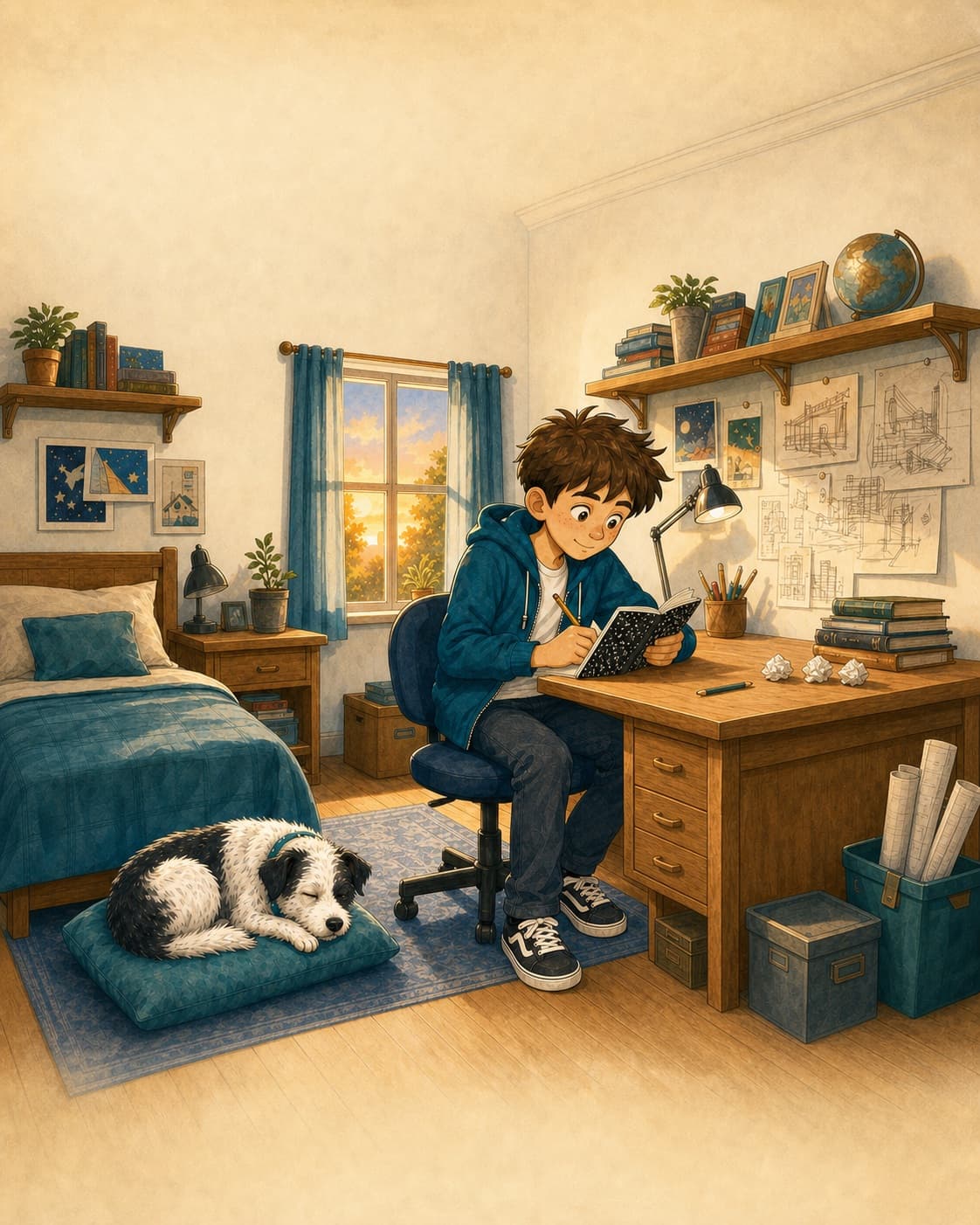
The illustrations create breathing room and carry jokes, clues, and reactions. The story still continues across all 50 chapters.
Sam means well. His certainty is part of the comedy, and his four friends do not let him control every version of the truth.
There are mistakes, blame, embarrassment, and disagreement, but no graphic danger, strong language, romance, or horror.
An open-book promise
The story is allowed to be a story. The useful ideas appear because five children need them, not because a lesson box interrupts the fun.
Explore the planning and teamwork themes →Try the voice, not the promise
You do not need to sell the book to them. Read the opening aloud, pause, and notice what the child does next.
A laugh means the humour found its reader.
A correction means they are already inside Sam’s point of view.
A question means the next chapter has earned attention.
“Adults say things like this when their name is not Sun Carton.”
Sam Carter, immediately after a lettering event
Keep the facts close
Open only what matters now. Age fit, tone, reading rhythm, ideas, illustrations, and the people behind the book are all here without production jargon.
Straight answer
Age labels help. Knowing what the pages actually feel like helps more.
Yes. The intended range is ages 9–12. The school setting, friendship trouble, short chapters, and frequent pictures suit middle-grade readers. A nine-year-old and a twelve-year-old may enjoy different parts, so personal interests and reading confidence still matter.
It is a funny illustrated chapter book with one continuous school story. More than 100 illustrations add reactions, clues, signs, and jokes, but the 50 chapters build one complete plot rather than a collection of separate cartoons.
The book is written for middle-grade readers rather than claiming one official classroom level. Short chapters and illustrations create breathing room, but the story still uses character voice, dialogue, consequences, and a continuous plot. The opening sample is the fairest fit check.
It could. Short chapters make progress visible, and frequent illustrations give the eye somewhere to land without replacing the story. Humour and familiar school trouble can help too. No format fits every child, so curiosity about Sam’s voice matters most.
Yes. Five distinct personalities, dialogue, visual jokes, and short chapters work well for shared reading. Families can pause to predict the next disaster or inspect an illustration, while independent readers can follow the same story at their own pace.
Straight answer
Enough detail to choose confidently, without spoiling where the plan lands.
Sam Carter creates an ambitious plan for a school project and expects preparation to protect the team from surprises. Weather, rules, missing information, and five different personalities prove otherwise. The friends must rebuild both the project and the way they work together.
The comedy comes from Sam’s enormous confidence, four friends with opinions, school rules, bad timing, visual misunderstandings, and a hamster appearing exactly where a sensible plan would not put one. The story does not need cruelty to keep the jokes moving.
The 50 chapters are deliberately short, giving readers frequent places to pause. The trouble does not reset when a chapter ends: choices carry forward, the project changes shape, and every chapter contributes to one complete story rather than unrelated episodes.
The story includes tension, embarrassment, arguments, setbacks, and moments when friendship feels uncertain, but it is not horror. The emotional tone changes with the scene and returns to warmth and hope without pretending every difficult feeling disappears immediately.
The central conflict involves school pressure, mistakes, dishonesty, blame, bad weather, and friendship tension rather than graphic danger. The story does not rely on romance or strong language. Sensitive readers who dislike social conflict may prefer to try the sample with an adult.
Yes. The book has its own beginning, escalation, consequences, and resolution. Sam’s world has room for future stories, but readers are not asked to continue elsewhere to receive the ending of The Very Bad Plan.
Straight answer
Useful ideas are present, but the story never introduces itself as homework.
It is written as a funny story first. Planning, honesty, friendship, listening, flexibility, shared credit, and progress over perfection matter because the characters need them. Those ideas arrive through choices and consequences rather than boxed lessons or a lecture.
Yes, although teamwork here includes disagreement. Sam’s idea improves when Ben, Mia, Omar, and Leo stop behaving like assigned helpers and contribute what they actually see. Sharing the work eventually means sharing the decisions, responsibility, and credit too.
The story shows planning in motion rather than offering a perfect formula. The friends choose a goal, divide work, meet constraints, miss things, gather new information, and revise. Changing the plan becomes evidence of attention rather than proof of failure.
Yes. The story opens questions about goals, roles, honesty, conflict, flexibility, and fair credit without becoming a lesson plan. Adults can ask one natural question after a chapter, or simply let the child enjoy the story without turning every joke into an exercise.
Straight answer
What the illustrations do, where the story came from, and who helped shape its visual world.
The book contains more than 100 illustrations across 50 chapters. They show expressions, signs, notebook scraps, physical comedy, spaces, posters, and turning points. Some images explain the moment; others quietly disagree with what Sam has just told the reader.
No. The illustrations follow the scene rather than a fixed quota. Some pages lean on dialogue or narration; other moments give the visual layer much more room. The goal is frequent meaningful pictures, not decoration added to satisfy a page count.
The illustrations carry story information as well as atmosphere. Readers can find reactions, visual jokes, clues, and emotional shifts that the prose does not repeat. They also create breathing room without turning the novel into a set of disconnected cartoons.
Ali Babaee wrote the book after years of making up stories for his children. Their enthusiasm encouraged him to turn one idea into a complete novel about planning carefully without missing the imperfect, funny life happening around the plan.
Sana Naseri contributed to visual concept development and image arrangement. Her role helped the illustrated moments work together across the book, supporting character recognition, page rhythm, emotional tone, and the relationship between each image and the surrounding text.
A real person at the other end
Parents, teachers, and librarians can write directly to Ali and The Very Bad Plan team. Ask about reader fit, a classroom idea, a library plan, or the odd detail a child noticed before any adult did.